
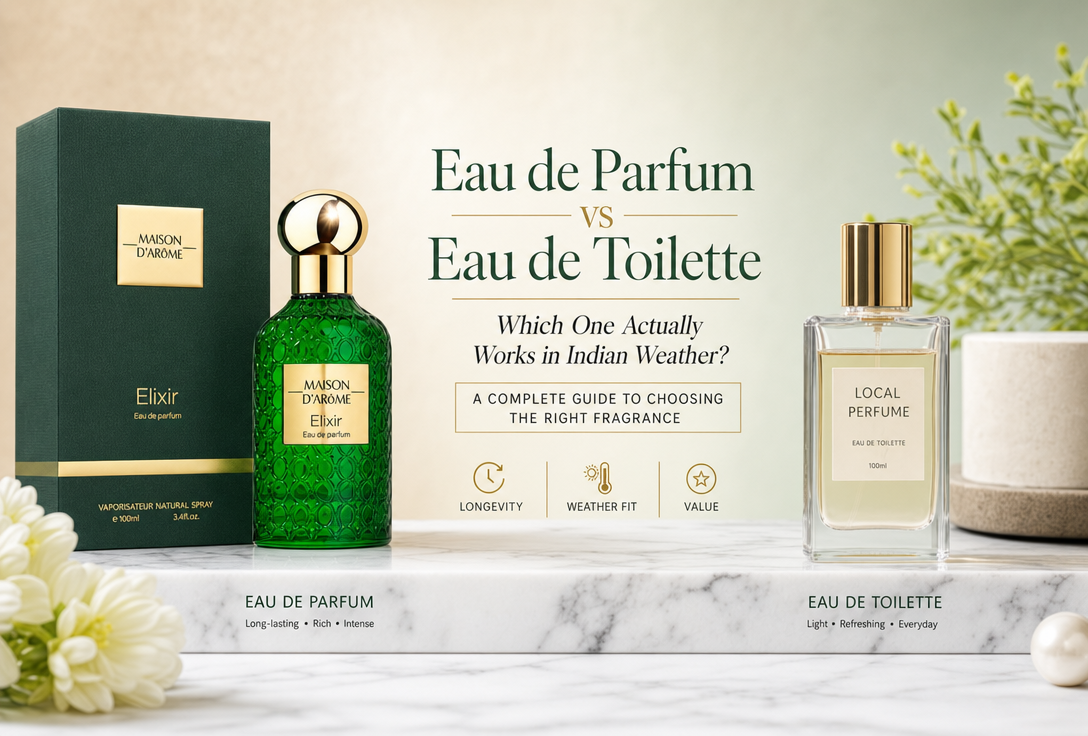
Eau de Parfum vs Eau de Toilette: Which One Actually Works in Indian Weather?
A working perfumer's take on the most misunderstood label on the bottle - written for the buyer who has paid the EDP premium without quite knowing why, and the buyer who has saved on EDT and wondered why it never lasts.
You walk into a perfume counter in Khan Market or Bandra. Pick up a bottle. Three letters on the box catch your eye: EDP. Or EDT. Sometimes Parfum, sometimes Extrait. The same fragrance - say, Dior Sauvage - comes in all three formats, often at wildly different prices. The salesperson tells you EDP is "stronger." A YouTube reviewer swears Parfum is "the only one worth it." A friend insists EDT is "all you need for Indian summer."
All three of those statements are partly right and mostly misleading. The honest answer lies in the chemistry, the formulation, and one fact most Indian guides skip: in a country where ambient temperatures sit above 30°C for seven months a year, the EDT-vs-EDP question doesn't have the same answer it does in Paris or New York.
This is the cheat-sheet I wish someone had handed me the first time I spent over ₹3,000 on a bottle. By the end you'll know exactly which concentration your skin, your weather, and your wallet should default to.
What concentration actually means
Every perfume is a mix of three things: aromatic concentrate (the perfume oils - the actual scent molecules), denatured alcohol (the carrier), and a small amount of distilled water. The percentage of aromatic concentrate is what defines the type.
Higher concentration doesn't just mean "stronger smell." It means more fragrance molecules per spray, which translates to longer development on skin, deeper base resolution, and slower evaporation. A 20% EDP isn't "twice as strong" as a 10% EDT - it's structurally different on your skin, with a longer dry-down arc and a heavier, more developed heart and base.
The IFRA-aligned bands every legitimate perfume house works within look like this:
| Type | Oil % | Cool climate | Indian summer | Price |
|---|---|---|---|---|
| Eau Fraîche | 1–3% | 1–2 hrs | 30–60 mins | 0.5x |
| Eau de Cologne | 2–5% | 2–3 hrs | 1–2 hrs | 0.6x |
| Eau de Toilette (EDT) | 5–15% | 3–5 hrs | 2–4 hrs | 1x |
| Eau de Parfum (EDP) | 15–20% | 6–10 hrs | 4–8 hrs | 1.3–1.5x |
| Parfum / Extrait | 20–40% | 8–24 hrs | 8–16 hrs | 2–3x |
Two things to notice. The gap between EDT and EDP isn't subtle - it's roughly double the longevity. And Indian climate compresses everything: an EDT that lasts five hours in a Lyon spring will give you under three in a Pune July.
EDT, honestly
EDT is the workhorse of European perfumery. At 5 to 15% concentration, it's light, airy, and built around a generous opening - bright citrus, fresh florals, aquatic notes. The formula is meant to bloom in the first 30 to 60 minutes and fade gracefully into a soft skin scent over three to five hours.
In moderate climates, this is brilliant. It's what makes EDTs feel "summer-fresh" - they're built around the assumption that the wearer might re-apply once during the day and that ambient heat won't destroy the structure. Some of the most loved fragrances in history are EDTs: Chanel No. 19 EDT, Acqua di Parma Colonia, Guerlain Shalimar Légère.
In Indian weather, EDT becomes much harder to defend. At 38°C with 70% humidity, the entire light architecture collapses. Top notes vanish in 15 to 20 minutes. The heart never quite blooms. By lunch, you're wearing residual base molecules at a fraction of the projection the perfumer intended.
EDT still has a place here. For an early-morning workout, a casual Sunday brunch, an AC office where you actually want a fragrance that fades politely, EDT works. As your only-bottle, all-day signature scent in Indian weather - it's the wrong choice.
EDP, honestly
EDP is where modern perfumery has been quietly migrating for fifteen years. At 15 to 20% concentration, it sits at the sweet spot of projection, longevity, and wearability. The opening is still recognisable, but the heart is denser, the base develops more fully, and the fragrance lives on skin for 6 to 10 hours in temperate climates and 4 to 8 in our heat.
Important: an EDP isn't just a "stronger version" of the EDT it shares a name with. The formulas are usually different - adjusted base accords, different fixative ratios, sometimes entirely different perfumer briefs. Dior Sauvage EDT, Sauvage EDP, and Sauvage Elixir are three distinct compositions, not three strengths of the same juice. This is why a friend can love one and dislike another with the same name on the bottle.
For Indian weather, EDP is the default that makes sense. The 15 to 20% oil load gives you enough heavy-molecular weight base notes - sandalwood, ambroxan, oud, vanilla, musk - to survive evaporation above 30°C. The price premium over EDT is usually 30 to 50%; the longevity premium in Indian heat is closer to 100%. Hour-for-hour, an Indian formulated EDP is the better economic decision.
This is exactly the bet Maison D'Arome has made. Every fragrance in the house is composed as an EDP at 18 to 20% oil, with formulation choices - heavier sandalwood loads, ambroxan fixation, lower citrus dependence - calibrated for the fact that the wearer is in Bombay or Bangalore, not Bordeaux.
Parfum, Extrait, Elixir - what's going on?
This is the corner of the perfume aisle that confuses most buyers. Parfum, Extrait, Pure Parfum, and the newer Elixir formats all sit above EDP, with concentrations from 20% all the way up to 40% in the heaviest Extraits.
Parfum (or Extrait de Parfum) is the highest classical concentration. It's dabbed, not sprayed, and lasts 8 to 16 hours even in Indian heat. The arc is intimate - projection is lower than EDP because the alcohol carrier is reduced - but skin scent runs all day. Think of it as wearing a scent you live inside, not a scent you broadcast.
Elixir is a marketing-led sub-format that has exploded since 2020 - Dior Sauvage Elixir, YSL Y Elixir, Valentino Born in Roma Intense. These typically sit at 20 to 30%, with formulas re-engineered for high projection and long wear. They've effectively replaced what used to be called "Intense" editions.
Most Indian articles treat all of these as identical. They are not. A Parfum is dab-and-drift; an Elixir is spray-and-project. If longevity is everything to you and you only buy one bottle a year, an Extrait is the technically correct answer. If you want EDP-level projection with Parfum-level wear, an Elixir is closer to what you actually want.
Side-by-side, in our weather
| Factor | EDT | EDP |
|---|---|---|
| Oil concentration | 5–15% | 15–20% |
| Indian summer wear | 2–4 hrs | 4–8 hrs |
| Sillage | Light, close | Stronger, room-filling |
| Best for | AC offices, evenings, monsoon mornings | Daily wear, weddings, heat |
| Price premium | Baseline | +30 to 50% |
| Ideal occasion | Breakfast meeting, gym, casual brunch | Office, dinner, all-day events |
The honest take: if you wear perfume to be remembered, choose EDP. If you wear it only to feel a private bloom for a couple of hours, EDT is enough. Most Indian buyers will be happier owning two EDPs than four EDTs.
Price per hour of wear: the number nobody calculates
The smartest way to compare a ₹3,500 EDP with a ₹2,800 EDT isn't sticker price - it's price-per-hour of wear. A 100 ml bottle of either gives you roughly 700 to 1,000 sprays, but each spray of an EDP delivers nearly twice the wear-time.
Indian comparison: a 100 ml Tom Ford Tobacco Vanille EDP retails around ₹26,500 and gives 6 to 7 hours per spray in our summer. A Maison D'Arome Tobacco Noir EDP, formulated at 18% oil with comparable base accords, retails around ₹3,200 to ₹3,600 - roughly one-eighth the price for similar concentration and a formula tuned for our climate. The price per-hour-of-wear difference isn't 10 or 20%; it's a different planet.
The same logic applies inside any single brand's range. If you're choosing between the EDT and EDP of the same fragrance, the EDP is usually the better long-run buy in India - even at a 40% premium - because the wear-time premium is closer to 100% in our weather.
Reading the label
- "Eau de Toilette" or "EDT" - light, fresh, expect 2 to 4 hours in India. Best for brief or AC-bound moments.
- "Eau de Parfum" or "EDP" - the modern default. 4 to 8 hours in India. The all-around right choice for our weather.
- "Parfum" or "Extrait de Parfum" - highest classical concentration, intimate sillage, extreme longevity. Dab, don't spray.
- "Elixir," "Intense," or "Absolu" - modern intensified formats. Often re-composed, not just stronger. Read the notes carefully.
- "Cologne" - in the Jo Malone or classical sense, this is closer to EDC at 2 to 5%. Lovely in monsoon. Will not survive an Indian summer afternoon.
When to wear which
- Daily wear (any season, including peak summer): EDP at 15 to 20%, anchored in sandalwood, ambroxan, oud, vanilla, or musk. Your default.
- Office and meetings: EDP, slightly lighter - fresh florals, citrus EDPs, soft woods. Maison D'Arome's Reve and Elixir EDPs both fit here.
- Evening, dinner, date: EDP or Elixir. Heavier compositions - Tobacco Noir, Luxure - bloom in cooler air after sundown.
- Wedding, festival, all-day event: Parfum or Elixir. The days you spray once at 9 a.m. and still smell yourself at midnight.
- Workout, beach, casual: EDT or EDC. Use the lower concentration where the short wear is a feature, not a bug.
- Monsoon and overcast days: EDP works beautifully; the cooler ambient temperature buys an extra hour or two of wear. Skip pure aquatics - they collapse into nothing in 80% humidity.
The Indian buyer's default
Here's the rule I tell every customer who walks into the Maison D'Arome flagship - and it works almost universally.
If you live anywhere in India where summer crosses 30°C for more than two months a year, your default purchase should be EDP, not EDT. Period. The longevity in our climate, the base resolution, the cost-per-hour math - every factor points the same way.
EDT belongs in a smaller corner of your perfume wardrobe - for AC offices, monsoon mornings, evenings under 25°C, or as a layering tool over an unscented body lotion. It shouldn't be your primary bottle.
FAQs
EDT or EDP for Indian weather?
EDP, almost always. The 15 to 20% oil load gives you twice the wear of EDT in our heat, and the heavier base notes survive evaporation above 30°C.
Why is EDP more expensive?
More aromatic concentrate per bottle, and the premium ingredients - natural sandalwood, oud, jasmine absolutes - are the most expensive part of any formula.
Does EDP really last longer than EDT?
Yes, by roughly double in our weather. An EDT that gives you 3 hours is matched by an EDP at 6 to 8.
Parfum vs EDP?
Parfum (Extrait) sits at 20 to 40% - closer to skin, longer wear, lower projection. EDP projects more in the first hour but fades sooner.
Can men wear EDP?
Of course. Concentration has nothing to do with gender. Most modern men's fragrances are released in EDP precisely because the format suits how men actually wear scent.
The Maison D'Arome take
The EDP-vs-EDT debate in India has a surprisingly clean answer once you stop comparing labels and start comparing formulas to the climate. EDPs survive Indian heat. EDTs don't - at least not as the all-day fragrance most buyers actually want.
Maison D'Arome's eight EDPs are formulated at 18 to 20% oil with bases chosen for thermal stability above 30°C - sandalwood, oud, vetiver, vanilla, musk, ambroxan. The same molecules that let a Tom Ford EDP last six hours on a Manhattan winter morning will give you seven to eight in Bombay June, because the formula assumes the heat instead of fighting it - at one-eighth the price.
If you've been hesitating between an EDT and an EDP for your first serious bottle, choose the EDP. If you'd like to test before committing, the Maison D'Arome discovery set ships free on prepaid orders - three days of wearing four samples through a real Indian week will settle the question for you in a way no chart ever can.
Read more
Tobacco Vanilla Perfume in India: 7 Best Picks (2026 Guide)
A good fragrance is noticed.A great one is remembered. Among all fragrance profiles, tobacco vanilla stands out for its depth, warmth, and addictive character. It’s rich without being overwhelming,...
Read more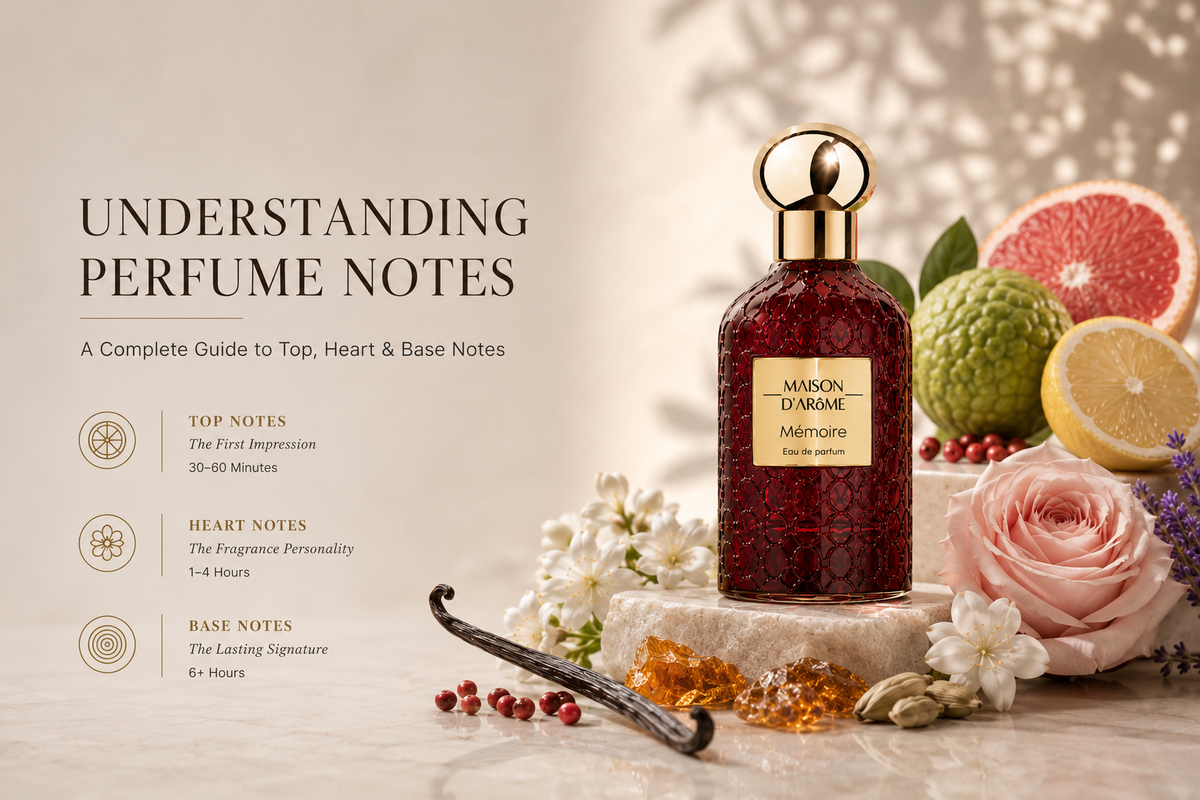
Perfume Notes Explained - How Fragrances Actually & Work
A fragrance doesn’t reveal itself all at once.It unfolds - slowly, quietly - and that’s what makes it memorable. If you’ve ever sprayed a perfume and noticed it changing over time, you’ve already e...
Read more