
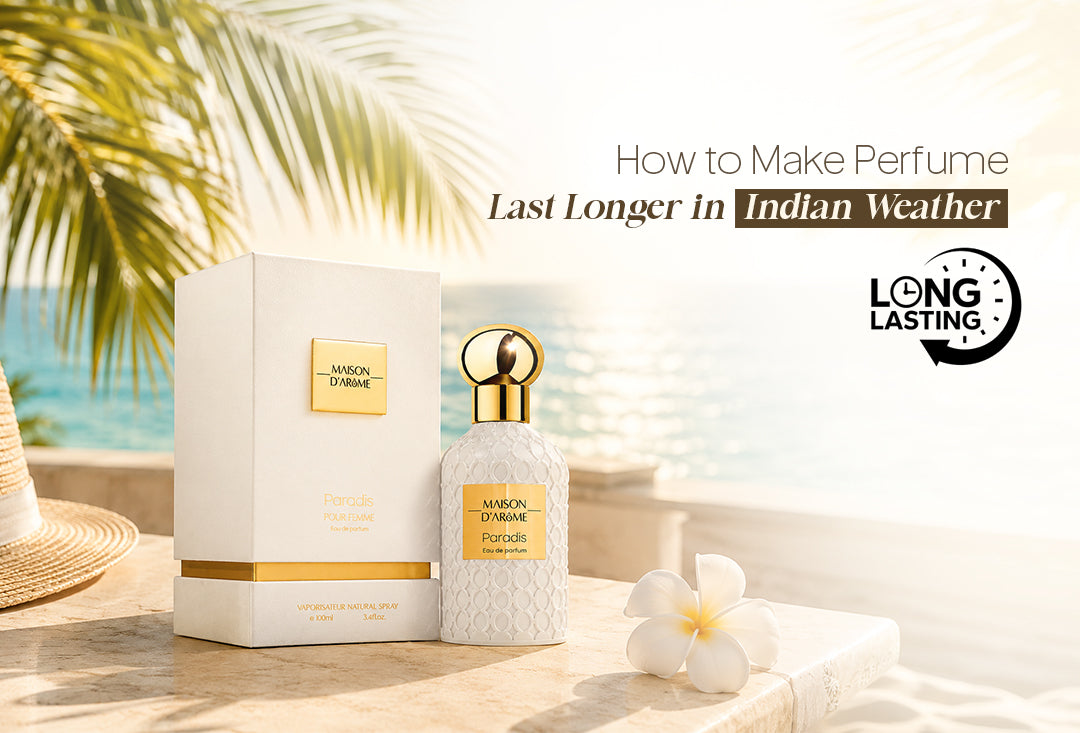
How to Make Perfume Last Longer in Indian Weather
Honest, hands-on advice from someone who has worn EDPs through Delhi summers, Mumbai monsoons, and the kind of Bangalore evening where the AC office becomes a 38°C parking lot in 90 seconds.
It's two in the afternoon. I'm standing outside a café in Khan Market, the car thermometer behind me reads 43, and I lift my wrist to my nose out of habit. Nothing. Six hours ago I sprayed something I genuinely love - the same perfume that smelled rich and complicated on the blotter at the store - and now it's just gone. Not a soft skin-scent. Just gone.
If that has happened to you, you are not imagining it, and you are not "anosmic to your own skin." Your perfume is, quite literally, evaporating off you faster than its formula was ever designed to handle.
Most longevity advice on the internet was written for European weather - a polite 20°C with 50% humidity, the conditions French perfumers calibrate around. Indian skin in Indian weather is a different problem. Heavier sweat, harsher sun, ridiculous humidity swings, AC offices that you exit into a wall of heat. So this is the guide I wish someone had handed me the first time I spent serious money on a bottle and watched it disappear by lunch.
By the end, you'll know why your perfume fades, what to actually change, and which notes to buy if longevity matters to you.
Why Indian weather is brutal on fragrance
Perfume is just aromatic molecules suspended in alcohol. They're meant to evaporate slowly off your skin in a sequence - top notes, then heart, then base - so you experience the full arc the perfumer composed. Heat speeds that evaporation up. Humidity changes how your skin holds and releases scent. Indian summer does both at once, and badly.
In peak summer, most of urban India sits between 35 and 47°C. Humidity swings from a bone-dry 25% inland to a punishing 90% on the coasts. Once the air crosses 30°C, the volatile little molecules in your top notes pick up speed and disappear faster - that bergamot or grapefruit opening that's supposed to last an hour can vanish in twenty minutes. Add monsoon humidity to that and the alcohol carrier struggles to flash off, which muddies the heart accord and the whole thing smells "off."
There's a second factor most guides skip: Indian skin chemistry. Sebum-rich, mid-to-oily skin is actually a longevity advantage - oil holds onto fragrance and adds an extra hour or two over dry skin. But Indian sweat-pH varies more than in temperate climates. Across a single day, the same skin can shift 0.5 to 1.0 pH units, which sharpens florals and dulls citrus. Knowing this is half the game.
Get your concentration right first
Before any application trick can save you, the bottle on your dresser has to be the right kind of bottle. Concentration - the percentage of perfume oils suspended in alcohol - is the single biggest predictor of longevity in Indian heat.
| Type | Oil % | Cool climate | Indian summer |
|---|---|---|---|
| Eau Fraîche | 1–3% | 1–2 hrs | 30–60 mins |
| Eau de Cologne | 2–5% | 2–3 hrs | 1–2 hrs |
| Eau de Toilette (EDT) | 5–15% | 3–5 hrs | 2–4 hrs |
| Eau de Parfum (EDP) | 15–20% | 6–10 hrs | 4–8 hrs |
| Parfum / Extrait | 20–40% | 8–24 hrs | 8–16 hrs |
Honest take: if you live anywhere in India that's above 30°C for most of the year - which is most of urban India for at least seven months - default to EDP, not EDT. The price difference between them is usually 30 to 50%. The longevity difference in our weather is closer to 100%. Hour-for-hour, EDP is the smarter buy.
This is exactly why every Maison D'Arome fragrance is composed as an EDP at 18 to 20% oil, with bases tilted toward the heavy molecular weights that survive Indian heat - sandalwood, oud, vetiver, ambroxan, vanilla, musk. Built around the climate, not retrofitted to it.
Prep your skin like you mean it
Application is honestly the last 30 seconds of a process that starts in the bathroom. The single most powerful longevity hack costs nothing and adds two to three hours.
Apply within 5 to 10 minutes of stepping out of the shower. Pores are open, skin is still warm, and the residual moisture acts like a holding medium for fragrance molecules. Studies and perfumer consensus put the boost at 30 to 50%.
Moisturise first. This one I'll keep saying till people listen - dry skin is the silent killer of fragrance in India. Skin without a lipid layer simply cannot hold onto aromatic molecules; they evaporate or absorb too fast. Use an unscented body lotion, or, on pulse points only, a paper-thin smear of plain Vaseline. The petroleum jelly trick is folk wisdom for a reason: the occlusive layer slows evaporation and adds an honest 30 to 50% to wear.
Apply perfume before clothes, not after. Your skin needs to receive the full development arc. Spraying perfume on top of a kurta or silk saree stains the fabric, locks the scent into the cloth where it never blooms, and skips the body-chemistry interaction the perfumer composed for. The exception: spray a fine cloud in front of you and walk through it for a soft halo on outerwear.
A 7-step morning routine you can actually do
Indian mornings are chaos. This routine fits in the 12 minutes between shower and door.
- Shower. Towel off so skin is just damp, not dripping.
- Massage in unscented body lotion across décolletage, inner arms, behind the ears.
- Dab a pin-head of Vaseline on each pulse point you plan to spray.
- Hold the bottle 15–20 cm from skin and spray once each on inner wrists, base of throat, behind the ears.
- Don't rub the wrists. Every Indian uncle who taught you to "rub it in" was wrong - friction creates heat and shatters the volatile top notes.
- Spray the inside collar edge of your shirt once for slow ambient release.
- Get dressed. Mist a light cloud in front of you and walk through it.
Total time: under three minutes. Longevity gain over a casual one-and-done spritz: usually 4 to 5 hours, no exaggeration.
Pulse points, ranked
Every fragrance article says "pulse points." Few rank them honestly. Here they are, in order of how much they actually do for you in Indian wear:
- Inner wrists. Easy, classic, and you can re-mist subtly through the day.
- Base of throat / décolletage. High heat, strong upward projection. Best place if you want people to actually notice.
- Behind the ears. Intimate scent for close conversations.
- Inner elbows. Brilliant in short sleeves, sheltered from sweat, surprising longevity.
- Behind the knees. Comes alive when you're in a saree, skirt, or shorts.
- Nape of the neck. Radiates beautifully without friction from clothing.
- A mist through your hair. Hair holds scent better than skin - but never spray alcohol-based perfume directly on the scalp. Spray a brush, then run it through dry hair.
Skip the navel. It's almost always covered and contributes nothing.
The notes that actually survive Indian heat
Honestly, the single best longevity hack isn't a technique - it's buying the right notes in the first place. Heavy molecularweight aromatics resist heat. Light ones don't. This is physics, not preference.
Notes that thrive in Indian summer (heaviest first): oud, ambroxan, sandalwood, vetiver, patchouli, vanilla, tonka bean, leather, cedar, labdanum, benzoin, frankincense, musk.
Notes that vanish first: bergamot, lemon, grapefruit, mandarin, lavender, green apple, light aquatic accords, lily of the valley, mint, sea-salt accords.
This doesn't mean you avoid citrus forever - it means understanding that a fragrance whose entire identity rests on bergamot or sea spray will give you 90 minutes of pleasure and then go quiet. Save those for short evenings or AC environments. For all-day Indian wear, the best perfumes anchor on a heavy base - oud, sandalwood, ambroxan, vanilla, musk. It's why Maison D'Arome's Tobacco Noir, Arome De Bois and Memoire EDPs out-last European fragrances at twice the price: they're built around the molecules that survive a Chennai August.
Storage mistakes that quietly kill your bottle
Most Indians store perfume in the worst possible place: the bathroom shelf. Steam, swinging humidity, ambient temperatures often above 30°C - your fragrance is degrading long before you finish it.
The rules are simple. Store at 15 to 20°C. Keep bottles in their original boxes; UV light cracks top-note molecules within months. Avoid bathrooms, dressing tables near sunny windows, and the inside of cars. A wardrobe drawer or a dedicated cabinet shelf is ideal. The fridge is fine for fragrances you wear rarely - bring them to room temperature for an hour before spraying so the alcohol carrier flashes off cleanly.
Bottles stored well retain integrity for three to five years. Bottles stored on a Mumbai bathroom shelf can turn within twelve months - that strange sour note you sometimes get is oxidation, not "a bad batch."
The Indian-specific pain point: AC to outdoor
This is the moment no European guide warns you about. You step out of a 22°C office into a 41°C parking lot. Your skin temperature jumps eight degrees in 90 seconds. The volatiles in your perfume hit a sudden burst of evaporation - projection spikes for 15 minutes, then collapses.
Two things help. One, carry a 5 ml or 10 ml travel atomiser and re-mist a single pulse point as you leave the building (Maison D'Arome's testers slide into a clutch or laptop sleeve). Two, lean into base-heavy EDPs - Tobacco Noir, Arome De Bois, oud-anchored stuff - because the heart and base survive that thermal shock far better than a citrus top can.
For monsoon, the inverse rule: humidity above 80% slows alcohol flash-off and dulls projection. Spray slightly less - five sprays, not seven - and lean on hair and fabric, where moisture-resistance is actually on your side.
Switching by season
A signature scent is romantic. A small wardrobe of three or four bottles is more honest for Indian life.
Summer (April to June): EDPs with heavy bases but lighter heart accords. Reve EDP for office, Elixir EDP for daily unisex wear. Avoid heavy gourmands; they get cloying.
Monsoon (July to September): Sharper, woody, slightly drier compositions cut through wet air. Arome De Bois, Memoire. Skip aquatic notes - they collapse into nothing in humidity.
Winter (November to February): Finally, India lets you wear what every European house was designed for. Tobacco Noir, Luxure, full-fat oud and amber. What was 5 hours of skin-close wear becomes 10. Wear them now.
FAQs
Why doesn't my perfume last in India?
Usually three things at once: you're wearing an EDT instead of an EDP, you're applying to dry skin without lotion, and your perfume is built on top-heavy notes that vanish above 30°C.
Does Vaseline really make perfume last longer?
Yes. The occlusive layer slows evaporation by 30 to 50% on pulse points. Use a pin-head amount; more isn't better.
Skin or clothes?
Skin first, always - that's where perfume develops. A light fabric mist layers projection, but skin is the canvas the perfumer composed for.
How many sprays should I use?
Four to six for an 8-hour Indian day. Two on the wrists, one on the throat, one behind each ear.
Can I keep perfume in the fridge?
In summer, yes. Wrap the bottle in cloth, and bring to room temperature 30 to 60 minutes before spraying.
The Maison D'Arome take
The real answer is simpler than ten clever tricks. Buy a perfume engineered for the climate you actually live in, and apply it on prepped, moisturised skin within ten minutes of a shower. Maison D'Arome's eight EDPs are formulated at 18 to 20% oil with bases - sandalwood, oud, vetiver, ambroxan, vanilla, musk - chosen for their thermal stability above 30°C. The same juice that lasts six hours on a Parisian afternoon will give you seven to nine in a Bombay June, because the formula assumes the heat instead of fighting it.
Try the discovery set if you're new to the house - it ships free on prepaid orders, and three days of wearing samples through a real Indian week will tell you more about longevity than any blog ever could.
Read more
Which Perfume Should I Buy? (A Simple Guide That Actually Helps)
Let’s be honest — choosing a perfume isn’t easy. You open a few options… They all sound good… Some smell great for a moment… And then you’re stuck thinking: “Which one should I actually buy?” If...
Read more
Tobacco Vanilla Perfume in India: 7 Best Picks (2026 Guide)
A good fragrance is noticed.A great one is remembered. Among all fragrance profiles, tobacco vanilla stands out for its depth, warmth, and addictive character. It’s rich without being overwhelming,...
Read more